
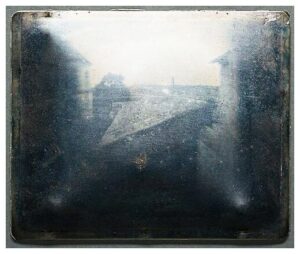
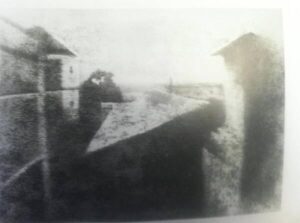
The history of photography begins with an image that, at first glance, may seem little more than a blurry surface. Yet that shot represents one of humanity's greatest technological achievements. It is “View from the window at Le Gras”, created around 1826 (according to some scholars in 1827) by the French Joseph Nicéphore Niépce.
The image is considered the first permanent photograph never realized. Niépce managed to fix a view of the courtyard of his country house in Saint-Loup-de-Varennes, France, onto a plate after an exposure that historians estimate to be between eight hours and several days, according to reconstructions. The most widespread theory speaks of approximately eight hours of exposure, which is why sunlight appears on both sides of the buildings: during the very long exposure, the sun had traveled across the sky, illuminating the scene from different angles.
A revolutionary procedure
To obtain the result, Niépce used a process he called heliography. The technique involved a pewter plate covered with bitumen of Judea, a substance that hardens when exposed to light. After exposure, the soft parts were removed with a solvent, leaving the image imprinted.
Compared to today's standards, the process was extremely slow and complex, but it demonstrated for the first time that light could create a permanent image without manual drawing.
The beginning of a new era
Niépce's experiment paved the way for research that, a few years later, led to the development of the daguerreotype through collaboration with Louis Daguerre. From that moment on, photography began a rapid evolution: exposures went from hours to minutes, then to seconds, and finally to the thousandths of a second of modern digital cameras.
Today, a camera can capture dozens of images per second with a quality unthinkable two centuries ago. However, it all began with that simple view captured from the window of a French country house.
A masterpiece that changed history
Niépce's image is not striking for its sharpness or artistic composition. Its value lies in its historical significance: it is the moment when humans succeeded, for the first time, in permanently capturing light.
From that plate exposed for hours sprung documentary photography, photojournalism, cinema, and ultimately, the entire digital image culture that accompanies our daily lives. After almost two hundred years, that photograph continues to remind us of how extraordinary was the first step towards one of the most influential communication mediums in history.
 Italian
  English
  German
  French