
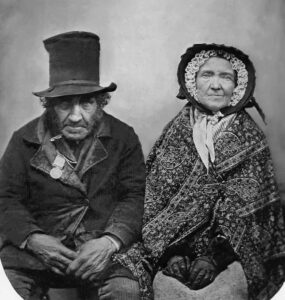
In the heart of the 19th century, during an era when photography was taking its first steps, a moment of rare intensity was immortalized: an elderly veteran of the Napoleonic Wars poses beside his lifelong companion. The image, likely taken between 1850 and 1860, reveals the stern yet dignified features of a man who weathered the storm of History, survived one of Europe's most devastating conflicts, and now faces old age with the same steadfastness.
The man wears a tall hat, a modest but neat suit, and most importantly, a medal pinned to his chest: a tangible symbol of his military past. It could be the St. Helena Medal, established by Napoleon III in 1857 to honor veterans of the Napoleonic campaigns. His direct and penetrating gaze seems to tell, without words, the weight of years, battles, and memory.
Beside him, his wife sits with composure. She wears a typical Victorian-era headdress, adorned with lace and ribbons, and a finely embroidered shawl that reveals care and dignity. Her face, serene yet intense, speaks to us of fidelity, resilience, and complicity—qualities forged in a shared life.
This photograph is not just a historical document; it's an emotional bridge to an otherwise distant past. It shows us war not just through battlefields, but also through what remains: love, memory, survival.
It's rare for an image to speak so clearly to the heart, but this portrait does. It reminds us that behind every historical event, there are real people, faces, intertwined hands, and lives marked by time.
 Italian
  English
  German
  French