
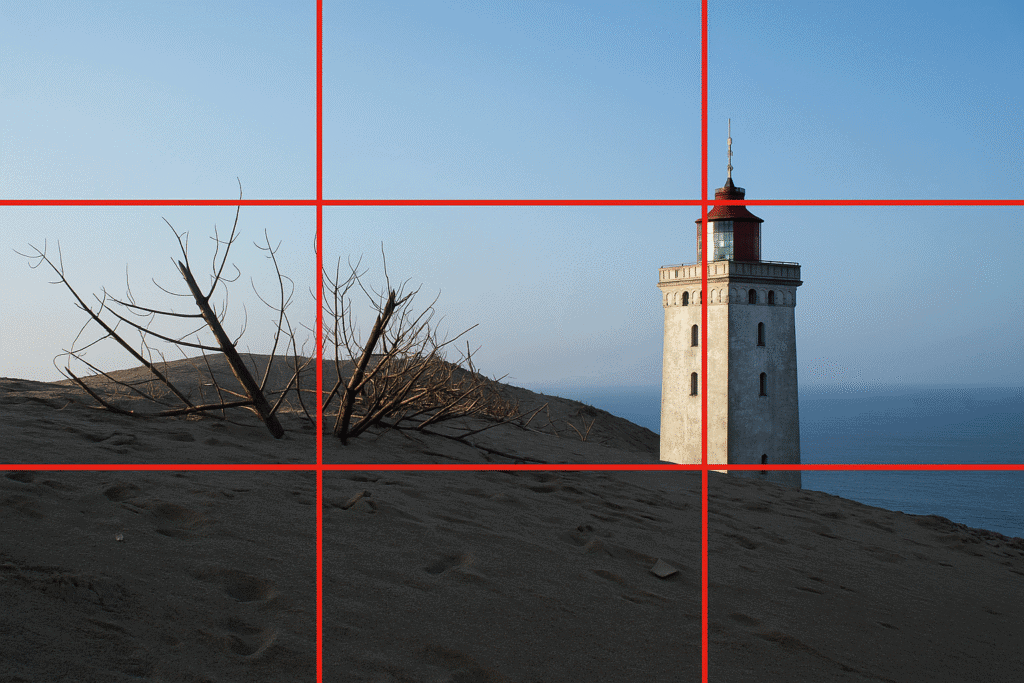
The visual composition it is the art of arranging elements in the image space so that they speak, guide the eye, and generate emotions. It is not enough for the subject to be interesting: the way you surround it, relate it to the environment and other elements determines whether the image will be simply “beautiful” or truly memorable.
The invisible foundations of composition
Every image is born from a choice: where to place the subject, how much space to leave around, which invisible line will guide the eye.
Behind these decisions are key concepts:
-
Focal pointthe element of greatest interest.
-
Guidelinesreal (roads, fences) or implied (alignments, outlines).
-
Visual weightSize, contrast, and color determine the “strength” of an element.
-
Negative spacethe void that makes the full stand out.
-
Depthclose-up, medium shot, background.
-
Angle and perspectiveThe point of view radically changes perception.
The classic rules that guide the gaze
Rule of thirds
Imagine your shot divided into a 3x3 grid. The intersection points are visual magnets: placing the subject or key elements here makes the composition dynamic and harmonious. Perfect for landscapes (high or low horizon) and portraits.
Golden spiral
An elegant curve that leads the eye from the outside inwards. If you arrange elements along the spiral, with the subject at the endpoint, you achieve a natural and harmonious flow. It's a refined rule, ideal for landscapes and narrative scenes.
Diagonals
Diagonal lines add movement and tension. A road, a river, a mountain ridge can guide the eye along a diagonal, making the image energetic and dynamic.
Pyramid / Triangle
A triangular setup conveys stability and direction. It is widely used in classical portraits and landscapes dominated by vertical elements.
S-curve
Curving lines that traverse the image invite the gaze to “wander” within the scene. Perfect for landscapes, waterways, and paths.
Shape L
A vertical element combined with a horizontal one frames or channels attention. Ideal for architecture or landscapes with trees and horizons.
Other useful schemesSymmetry (order and strength), the rule of odds (more dynamism with 3 or 5 subjects), natural frames (windows, arches, branches), and converging lines (perspective towards a vanishing point).
Subtle techniques that make the difference
Beyond the rules, there are compositional elements that elevate the quality of an image:
-
Visual balanceDistribute the weight between strong and weak elements.
-
Conscious use of negative spaceLeave empty spaces that enhance the subject.
-
Depth of fieldIsolate the subject with blur or include the background as narrative.
-
Unusual points of viewPhotograph from above, from below, from unusual angles.
-
Color, contrast, and textureNarrative devices that emphasize or harmonize.
-
Visual dynamicssuggesting movement even in static scenes through lines and repetition.
When to break the rules
Rules are not chains, but tools. Knowing how to break them consciously opens new creative possibilities.
-
A subject centered in a symmetrical scene conveys power.
-
A large lateral emptiness can evoke loneliness or anticipation.
-
A Dutch angle conveys tension or alienation.
The difference between an error and an artistic choice lies in intention.
Practical exercises to train the eye
-
Activate the 3x3 grid on your phone and take ten photos, varying the subject's placement.
-
Find a road or a river and compose following an S-curve.
-
Take the same shot with and without side balancing.
-
Try extreme angles: from the ground, from above, from close up.
-
Break a rule (subject centered, exaggerated white space) and compare the result with the classic version.
Conclusion
Composition isn't a rigid set of formulas, but a language. The Rules give you structure, the Conscious choices give you freedom. Learn the basics, experiment, observe: every image is a laboratory in which to grow and find your visual voice.
 Italian
  English
  German
  French