
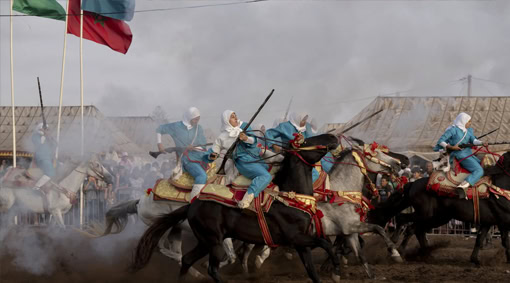
SThe winners of the world's most important photojournalism competition have been announced. More than 57,000 images, 141 countries, one goal: to show the truth. And this year, the truth is making people tremble.
Every year, I sit down in front of the World Press Photo exhibition with the same feeling: a mix of reverence and unease. These aren't beautiful photographs, in the conventional sense of the word. They are necessary photographs. And the ones from 2026 are among the most necessary I've seen in years.
The winners were announced this week, but the big wait is for April 23rd: on that day, in Amsterdam, the Photo of the Year 2026 will be proclaimed. A single image to represent everything the world has been in the past year. But even now, looking at the award-winning photographs, I find it difficult to imagine how one single image could be chosen.
The straw hat that toppled a government
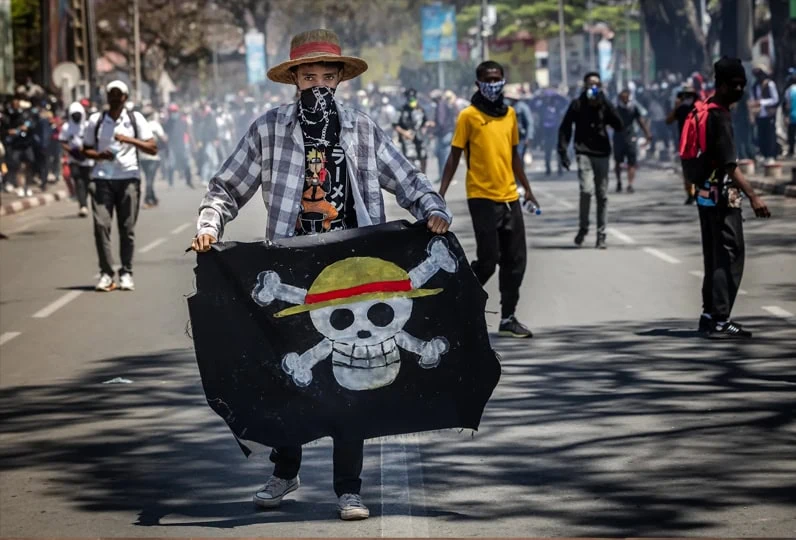
A student holds a flag. It is not the flag of Madagascar, nor that of a political party. It is the flag of the Straw Hat Pirates—that of Monkey D. Luffy, the protagonist of the Japanese manga One Piece, in which a group of pirates rebels against corrupt rulers to build a more just world. Antananarivo, October 9, 2025.
The story behind that flag is precise: in September 2025, students in Madagascar take to the streets against inefficient public services, corruption, and poverty. President Andry Rajoelina dissolves the government but refuses to resign. Protests intensify. On October 11th, the Capsat military unit—the same one that brought Rajoelina to power in a 2009 coup—defects and joins the protesters. A few days later, the military seizes power, promising elections within two years. A government overthrown. Lifted by a straw hat.
The image that stopped me
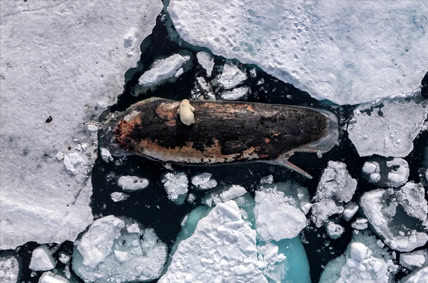
A polar bear feeding on the carcass of a sperm whale, amidst the ice of the Arctic Ocean, north of the Norwegian archipelago of Svalbard. Polar bears eat seals—or at least, that's their evolutionary plan. But the ice is retreating. The ice-free season in Svalbard has lengthened by twenty weeks in the last thirty years. And so the bear adapts, pushing further north, feeding on what it finds. Photographer Roie Galitz observed it for two entire days from a boat, in silence, waiting. The result is an image that, on its own, contains the entire climate crisis.
As a photographer, that scene hits me on multiple levels. There's the extreme technical difficulty: flat arctic light, a subject in motion against a white background, sub-zero temperatures. There's the endless patience of waiting. But above all, there's the realization that what we're seeing isn't an extraordinary spectacle: it's the new normal.
“Without photojournalism, we lose our historical memory. We lose the power to hold people accountable. We lose the ability to see what is happening around us.”
— Marie Monteleone, President of the Jury for North and Central America
The other story I can't forget
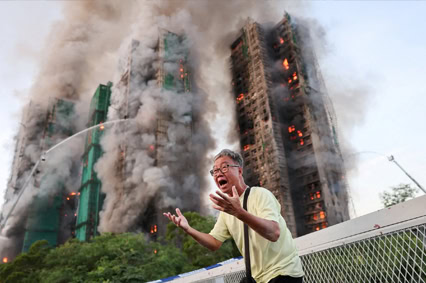
A man named Wong screams at a burning building in Tai Po, Hong Kong. Minutes earlier, he had called his wife, who was trapped inside. They said goodbye. The fire at the Wang Fuk Court residential complex killed 168 people, making it the city's deadliest tragedy since 1948. Bamboo scaffolding, construction netting, and expanded polystyrene panels – ordinary, everyday materials – had turned the building into a death trap. Over two thousand firefighters were on site. It wasn't enough. Tyrone Siu photographed that scream. I don't know how he found the strength to press the shutter.
What does this competition tell me, as a photographer
I sat with these photos for a while before writing this post. And I thought about how different my daily work is from that of these photographers. They take risks – the Arctic cold, war zones, the pain of others brought home every evening. I deal with other photography, on different scales. But there is one thing that unites all of us: the conviction that an image changes something.
The World Press Photo 2026 tells a story of a planet in motion, unstable, wounded in many places: the fires in Spain and Los Angeles, the drone wars in Ukraine, the immigration protests in the United States, the culling of elephants in Zimbabwe. None of these stories are comfortable. But they are all real. And photography is the only medium that can make them impossible to ignore.
I invite you to go to the World Press Photo website and take the time to look at these images. Really look, not just scroll. Let them sink in. They are uncomfortable, some are devastating. But that is precisely why they exist.
Photography is not decoration. It is documentation. It is responsibility. And it is why I continue to do it every day.
 Italian
  English
  German
  French