
Analog Photography · Technology
I'm Back is back for real: Sony sensor, APS-C format, and a Kickstarter already exceeding all expectations
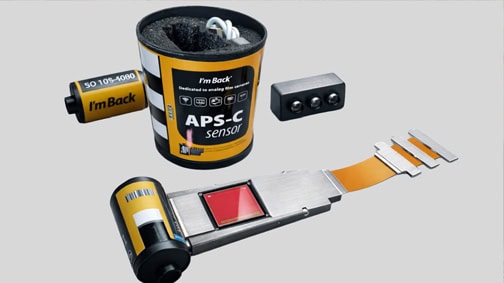
The digital back that turns any 35mm film camera into a modern camera has chosen the Sony IMX571. And I can't stop thinking about it.
There are ideas that strike me like a late afternoon sunbeam: you don't look for them, but when they arrive, you can no longer ignore them. I'm Back is one of them. The Swiss project that for years has been pursuing a seemingly simple dream — to give digital life back to any 35mm analog camera without touching it, without modifying it, without betraying it — has just launched its most ambitious Kickstarter campaign ever. And this time, I admit, I was truly impressed.
A roll that doesn't contain film, but a sensor. Not a replacement for the camera, but a second life for it.
The concept, in its elegance, is disarming: the digital back occupies exactly the same space as a film roll. You slide it into the housing, close the back, and shoot. The electronics—sensor, processor, connections—are hidden within the flat cable and flexible segments that embrace the winding mechanism. The cylindrical body of the “fake film roll” houses the lithium battery and the USB-C port for charging it. No modifications to the camera. No compromises. And, when you want, you can go back to real film.
The Qualitative Leap: The Sony IMX571
Previous versions of I'm Back used action camera sensors: functional, but far from the level a demanding photographer wants to reach. This time the team made a decisive choice: the Sony IMX571, a 26.1-megapixel back-illuminated CMOS (BSI) already known in the astrophotography world and recognizable as a close relative of the APS-C sensors that Fujifilm mounts in many of its cameras. The crop factor stops at about 1.5x — enough not to penalize wide-angle lenses too much, and compact enough to fit into any 35mm body without modifications.
Technical Sheet · I’m Back APS-C
How to shoot — and why I like this complexity
I admit it: the shooting procedure isn't as instantaneous as pressing a button. The digital back is controlled via a Bluetooth remote that attaches near the winding lever. The sequence is: cock the shutter, activate the sensor with the remote, and shoot. The sensor stays awake for a couple of seconds. It's an extra step compared to a normal camera – but it's also a ritual. And anyone who works with film already knows what it means to slow down, think, and anticipate.
The camera's original light meter works normally, as long as you set the same ISO values on the back. For videos, Bulb or Time pose is used, always controlled by the remote. It's a small and ingenious ecosystem, with its own internal logic that doesn't aim to replace a modern mirrorless camera, but to interact with machines that have decades of history behind them—including, and this particularly struck me, the Nikonos, the iconic analog underwater SLR.
A version for Leica M and a Kickstarter already exceeding expectations
For those who use Leica rangefinders, there's a dedicated kit, adapted for the specific housing of the M. And speaking of numbers: the team set the minimum feasibility threshold at 35,000 Swiss francs (around 38,000 euros). In the first hours of the campaign, it had already exceeded 160,000 euros. The project will happen—and I, looking at those numbers, found myself wondering how many Nikon F, Canon F-1, and Olympus OM cameras sleeping in drawers could go back to doing what they do best.
The 64 GB Super Early Bird package starts at 359 Swiss francs, just under 400 euros. It's not cheap, but it's not the price of a new camera body either. It's the price of a second life. And certain cameras, those you grew up with or inherited, truly deserve it.
 Italian
  English
  German
  French