
Astronomy & Optics — April 2026
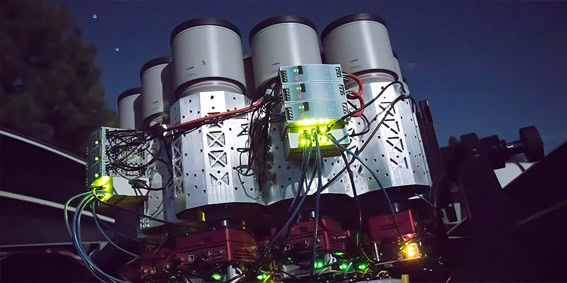
MOTHRA is not like every other telescope. It is a creature made of telephoto lenses, born to see what no mirror has ever seen.
Every time I read about an astronomical project that mentions Canon in a scientific press release, I stop. I sit down. I reread from the beginning.
This time it's MOTHRA— Massive Optical Telephoto Hyperspectral Robotic Array — a telescope under construction in the Chilean Río Hurtado valley, at the El Sauce Observatory. A name that evokes a Japanese monster from the fifties, and in a way, that's exactly what it is: a colossal creature that defies the laws of conventional optics, but assembled not with glass of impossible dimensions, but with telephoto lenses used for reporting. The same ones photographers use at the edges of soccer fields or at the foot of athletic tracks.
MOTHRA project in assembly phase. Image source to add (NASA / public domain recommended).
In the heart of the array there are 1.140 Canon EF 400mm f/2.8L IS Lenses, arranged on 30 robotic mounts, 38 optics per group. The idea — brilliant in its simplicity — is to sum the light-gathering capability of hundreds of high-end photographic optics to achieve the equivalent of a 4.7-meter diameter target. Without mirrors. Without the colossal architecture of large, traditional observatories.
Technical Specification · MOTHRA
Total optics
1.140 Canon EF 400mm f/2.8L IS
Configuration
30 frames · 38 optics each
Equivalent aperture
4.7 m diameter
Sensors
Sony IMX571 / IMX455
Location
El Sauce Observatory · Chile
Scientific objective
Ionized gas · Cosmic web
Why the 400mm f/2.8, and why EF
The choice of optics isn't romantic, but it is precise. Researchers from Yale and Toronto universities—Pieter van Dokkum and Roberto Abraham, the two astronomers behind the project—selected the Canon EF 400mm f/2.8L IS for its superior optical performance and anti-reflective coatings, which are essential when trying to intercept the faint emissions of the universe.
But there's a detail that I find even more curious, and that speaks to me as a photographer: they chose the version EF, not RF. The motivation is purely technical—the EF mount's flange focal distance allows for the integration of astronomy-specific accessories that the RF system, while more modern, does not permit due to its different geometry. It's a choice that reminds me how practical needs always override market trends.
Each group includes 38 Canon optics paired with the latest generation Sony CMOS sensors.
From Dragonfly to MOTHRA: Ten Times More Powerful
MOTHRA is not born out of nothing. It's the radical evolution of the Dragonfly Telephoto Array, a project I've followed with curiosity over the years: starting in 2013 with just three identical Canon lenses in New Mexico, growing to 48 units by 2021. A brave experiment, born from the conviction that the sum of many small eyes could be worth more than a single huge eye.
With MOTHRA, van Dokkum and Abraham determined that observing the diffuse ionized gas between galaxies – and mapping the theoretical dark matter structure we call the “cosmic web” – would require a tenfold increase in power compared to previous instruments. One thousand one hundred and forty targets are the answer.
Already at work, despite everything
Construction began in January 2026, and completion is expected by the end of the year. Yet, even at this partial stage, MOTHRA has produced images of extraordinary scientific value: among the first observations are the galaxy NGC 253 and the nebula RCW 114, also known as the Dragon's Heart Nebula. A name that seems tailor-made for a telescope named after a winged monster.
What strikes me, every time I find myself telling stories like this, is the double life of photographic instruments. A lens is born with a running athlete, a bird in flight, a face in the rain in mind. And then it ends up in Chile, pointed at an invisible gas connecting galaxies billions of light-years away. Optics doesn't know the difference. It collects light. And light is light, whether it comes from a soccer field or the dawn of the universe.
 Italian
  English
  German
  French