
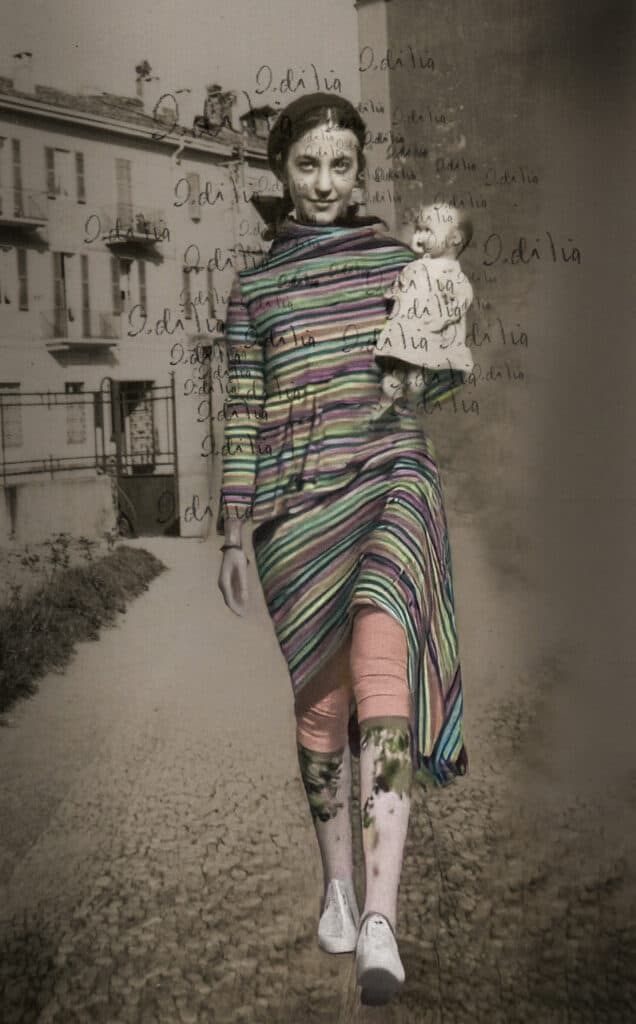
What remains of the past when voices fade and photographs yellow? For those who undertook the project The memory drawer, the answer is clear: everything remains if we know how to look at it.
Behind this work is a long personal journey, born from a simple gesture laden with meaning: opening a drawer. A real drawer, belonging to my mother, where old family photographs were kept. But also a symbolic drawer, a space in the mind where affections, faces, and stories are cherished. Inside, among black and white images and names written in pencil, the desire to give new voice to family memories was born.
The intimacy of memory
“I've been thinking about it for a long time,” confesses the project's author. The idea takes shape slowly, like a narrative that needs to find its rhythm. Family albums are rediscovered, the family tree is reconstructed. And then, by chronologically organizing the photographs, something sparks. The desire to make art with memory. To transform what was static into something new, alive, current.
The emotions don't take long to surface. Each photograph is a dive into childhood memories, into holidays spent in Monferrato with grandparents, into a time made of simple gestures and sincere affections. And while rereading these images, threads become intertwined, bonds are rediscovered, an identity is revealed that finds its roots in the past.
A memory dressed in contemporary style
The visual work is developed through a skillful use of contemporary technologies. The original photographs have been digitally reinterpreted using Photoshop's artificial intelligence: not to distort them, but to dress them. Literally. The subjects, who originally wore period clothing, have been “updated” with modern outfits, chosen with care and respect. “I thought about what they would have gladly worn,” says the author, “and how to enhance them aesthetically.”.
An aesthetic choice that becomes a temporal bridge. The figures thus appear suspended in a present that embraces the past, and the observer is drawn into a game of references and recognitions. In this hybrid dimension, time dilates, memory becomes fluid.
The handwritten names—originally noted by the mother on the back of the photos—become an integral part of the visual work. Printed on the faces, in different sizes, like an expanding affectionate echo, they are the first element we recognize. Because a name is identity. It is what remains, even when the face fades into memories.
A bridge between generations
“I wanted to make people who lived more than a century ago feel close to us,” explains the author. And indeed, looking at the images, one feels that invisible line connecting generations. The project thus transforms into a universal invitation to recognize oneself in the face of others, even strangers. To rediscover the value of memory as a collective force.
In a digital age where everything is volatile, where memory risks being overwhelmed by speed and excess, this work reminds us of the importance of “re-transcribing, printing, telling.” Because photography, when used consciously, still plays a fundamental role in preserving and reinterpreting who we are.
An evolving project
Among the images, there is one that stands out for its emotional intensity: that of the girl mother, dressed in black mourning her parents, but with a smile that endures. In that image, today reinterpreted with colorful and fun clothes, the entire poetics of the project is concentrated: giving new life to what seemed immobile.
The future of The memory drawer It remains open. It could continue with new photographs discovered, or transform into an exhibition, or an illustrated book that tells, with imagination and delicacy, the hidden stories behind each face.
Why, in the end, is memory never just something to be preserved? It's something to be brought to life again.
 Italian
  English
  German
  French