
The Photo-Rifle: When Science Shot Pictures
A brilliant insight between photography and ballistics
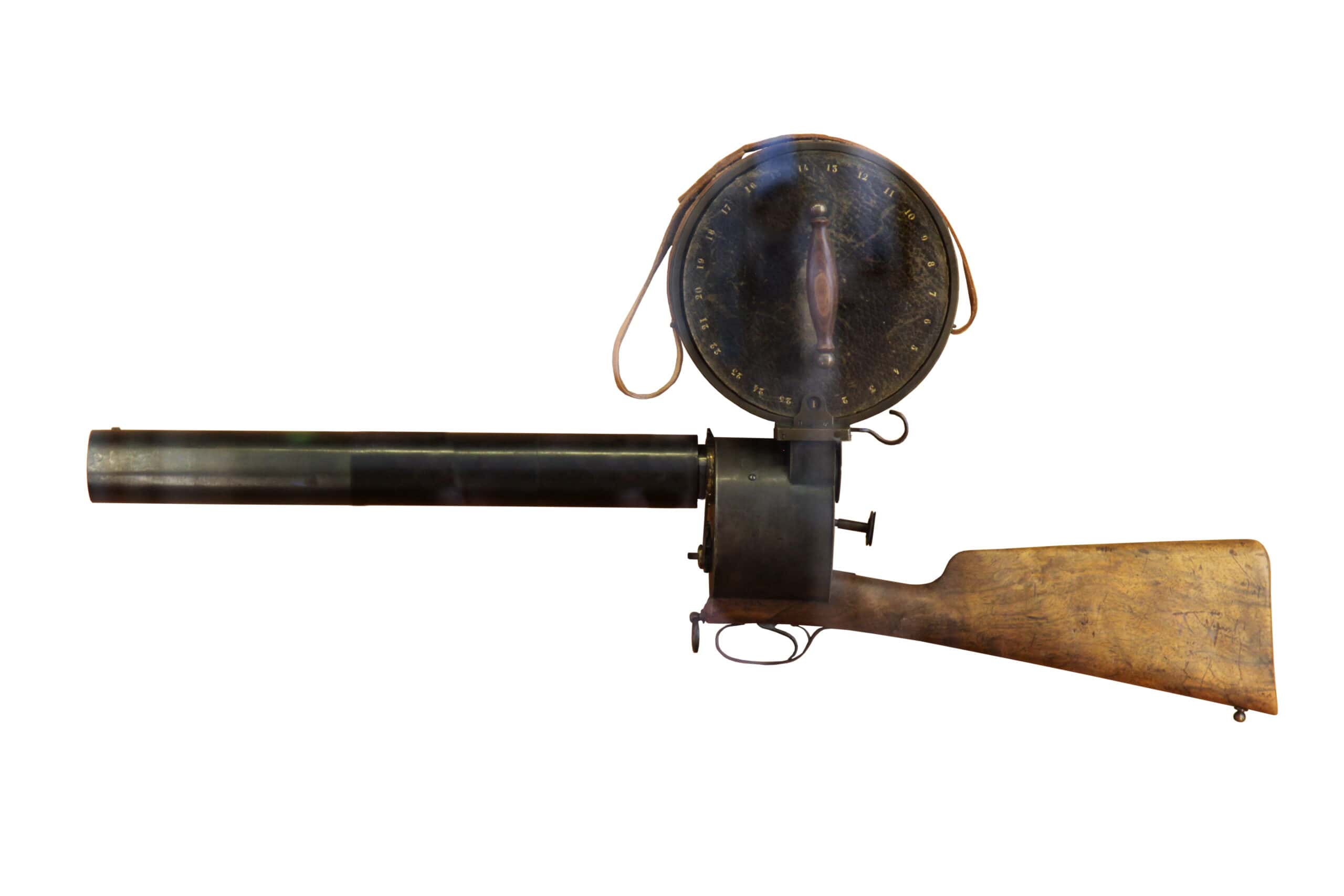
At the end of the 19th century, as photography took its first steps towards modernity and science sought new tools to observe the world, an instrument as curious as it was revolutionary was born: The camera gun. Invented in 1882 by the French physician and physiologist Étienne-Jules Marey, this device was not a weapon, but a pioneering innovation for the study of movement.
What is a camera gun?
The photogun is a hybrid between a camera and a rifle. Its appearance is deceiving: it looks like a firearm, but instead of bullets, it “shoots” images. The heart of the system is a rotary shutter mounted on a circular photographic plate, capable of capturing a series of shots in rapid succession. The result? A Series of images in temporal succession, true ancestors of moving images.
Marey's Invention and the Study of Motion
Étienne-Jules Marey was deeply interested in Physiology and to movement of living beings. He was looking for a way to scientifically analyze the dynamics of the human and animal body in action. The photographic rifle allowed him to capture 12 images per second on a 90 mm circular plate, an exceptional pace for the time.
The first major achievement of the invention was the analysis of bird flight. Until then, the mechanics of flight were poorly understood. Thanks to the photographic gun, Marey was able to show for the first time how wings move during flight – valuable information for physiology, biology, and even aeronautical engineering.
From chronophotography to cinema
Marey's work fits into a larger context: that of chronophotography, a technique used to record movements through sequential photographs. Parallel to him, also Eadweard Muybridge In the United States, similar methods were being explored, but Marey was the first to make the recording instrument portable and precise.
The photographic rifle, therefore, can be considered a direct ancestor of the cinematograph. It is thanks to these studies that photography began to merge with temporality, paving the way for the birth of movie theater.
A rare and fascinating object today
Today, original camera guns are museum pieces, kept in places like the Museum of Arts and Crafts in Paris. Despite their bizarre appearance, these objects represent a fundamental turning point in the history of imaging technology and bear witness to the creativity of scientists of the time in overcoming the technical limitations of photography.
The Legacy of the Photographic Rifle
Marey's approach left a lasting mark not only on photography and cinema, but also in Sports science, in the medicine, and even in the robotics, where the detailed study of motion remains a crucial element today. Furthermore, the photographic gun has inspired the design of modern tools for the analysis of athletic gesture, biomechanics, and animal behavior.
Curiosity
-
Marey was also a pioneer in Scientific graphHis studies included graphic visualizations of physical and physiological data, which still amaze today with their clarity and precision.
-
Unlike Muybridge's work (which used multiple fixed cameras), the photographic gun condensed everything into one instrument, making it more efficient.
Conclusion
The photographic rifle is a fascinating example of how innovation can arise from the convergence of multiple fields: photography, science, art, and technology. Today, even though it has been surpassed by digital and high-definition tools, it remains a symbol of human genius and our eternal curiosity towards movement, life, and time.
 Italian
  English
  German
  French