
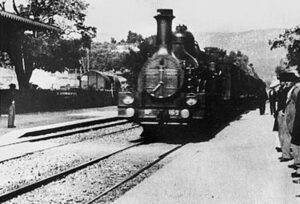
What a short film of only 50 seconds, The Arrival of a Train at La Ciotat Station directed by Auguste and Louis Lumière, it would become the most famous and retold short film in the history of cinema.
The legend: general panic and flight from the room
Popular historiography has passed down an almost mythological anecdote about that first screening:
As the gigantic mass of iron approached, the spectators, overcome by blind terror and convinced that the train was literally breaking through the screen to run them over, would begin to scream, hiding under their chairs or fleeing en masse towards the emergency exits.
For decades, this story has been cited as definitive proof of the hypnotic power of the new cinematic medium, capable of completely blurring reality and illusion for an audience not yet accustomed to moving images.
Historical reality: astonishment, not hysteria
Film historians have gradually downplayed the myth of “train panic,” highlighting how the audience's reaction was quite different from a hysterical flight:
-
Bewilderment and wonder In 1896, photography was already an established phenomenon, but seeing a photographic image suddenly come to life at life-size created a strong illusion of depth and movement.
-
Twists and turns: Some spectators recoiled in their seats or made an instinctive protective gesture. However, most were captivated by the realism of the details: the steam rising from the locomotive, the people disembarking from the carriages, the movement of the wheels.
-
Vintage Marketing: The narrative of “terrified people fleeing” was largely fueled and exaggerated by the newspapers of the time and the promoters of the Cinématographe themselves to create a stir and attract curious customers to the box office.
Why did the framing work so well?
The Lumière brothers, despite not having a codified cinematic grammar, applied a brilliant visual intuition:
-
Diagonal perspective: The camera wasn't positioned head-on, but at an angle to the tracks. This caused the train to enter the frame from a distance and then rapidly enlarge as it approached the corner of the screen.
-
Depth of field The image kept both the background (the arriving train) and the foreground (the travelers on the platform) in focus, amplifying the sense of three-dimensionality.
Although there wasn't a true stampede, the psychological impact was enormous: for the first time in history, humans saw reality reproduced with such dynamism that it made their senses falter for a moment.
 Italian
  English
  German
  French