
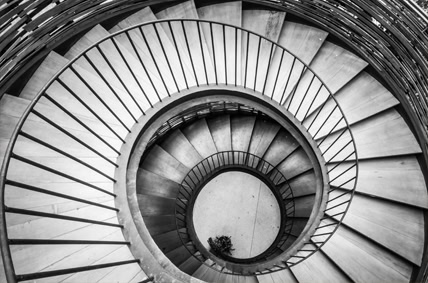
There is a proportion that has existed in nature for millions of years, that the ancient Egyptians used in the pyramids without even knowing its name, and that Leonardo da Vinci applied with obsessive care in his masterpieces. It is called Golden ratio, and ever since I started consciously using it in my photos, the way I look at a scene has changed forever.
I promise: no heavy math. Or almost.
What is it, in simple terms
The golden ratio is a relationship between two measurements—let's call them A and B—where the ratio of the sum of the two to the larger is equal to the ratio of the larger to the smaller. The resulting number is 1.618... and it is indicated by the Greek letter φ (phi).
This value occurs surprisingly often in nature: in the spiral of a snail's shell, in the arrangement of sunflower seeds, in the structure of a snowflake. It's not magic, but it's close.
A bit of historical context (which I find fascinating)
The golden ratio has its roots in the Pythagorean school, but it was probably already known in ancient Egypt: analyzing the proportions of the Great Pyramid of Giza between its height and half the base side length yields a value extraordinarily close to 1.618.
The letter φ comes from Fidia, the Greek sculptor who used it in the sculptures of the Parthenon.
And then there's the Fibonacci sequence — those numbers you've probably encountered in “The Da Vinci Code”: 0, 1, 1, 2, 3, 5, 8, 13, 21, 34... where each number is the sum of the two preceding ones. Kepler discovered in the 17th century that by dividing a number in the sequence by the preceding one, the result gets closer and closer to φ:
- 13 / 8 1,625
- 144 ÷ 89 = 1.6179
- 1.6180371352785146 1.61803...
Mathematics and nature speaking to each other. I find this simply beautiful.
Why should this be of interest to us as photographers?
Why do compositions follow these proportions are naturally pleasing to the human eye. It's not an opinion—it's something rooted in the visual perception we've developed by observing the natural world for
millennia.
And we photographers, deep down, are always trying to create images that strike, that last, that convey something. The golden ratio is one of the tools for doing so.
How do I actually use it when taking a photo?
1. The Golden Grid (similar to the rule of thirds, but different)
Everyone knows the rule of thirds—divide the frame into nine equal parts and place the subject on the lines or at the intersection points. The golden ratio grid works similarly, but the lines don't divide the sides into equal parts: they follow the golden ratio, resulting in lines slightly closer to the center.
In practice, the lines of force are tighter, and the intersection points are located in a slightly different position. For portraits, for example, I like to align the subject's eyes with one of these points — the result is almost always more balanced compared to the classic rule of thirds.
2. The Golden Triangle
This method surprised me with its elegance. You draw the diagonal of the frame and then drop a perpendicular from one of the opposite corners to meet it. You get three triangles, and the point where the lines intersect becomes the natural strong point of the scene.
Four possible combinations, depending on which diagonal and which corner you choose. Great for dynamic compositions, with subjects in motion or diagonal lines already present in the scene.
3. The Golden Spiral
The most complex to apply in the field, but also the one that yields the most satisfying results. It is constructed starting from the golden rectangle, dividing it into progressively smaller squares and tracing a quarter circle within each one — the result is that spiral which you have probably already seen superimposed on famous photographs or paintings by Leonardo.
The center of the spiral indicates where to place the main subject. The curve itself suggests a line along which to distribute the secondary elements of the composition.
I find it particularly useful in post-production: both Lightroom and Photoshop have the golden spiral integrated into their crop tools. I often shoot with a little extra margin precisely so I can apply it during processing.
Any final thoughts
You don't need to be obsessed with geometric precision. Nodon't measure pixels on the monitor before shooting. The goal is to train the eye to to hear these proportions instinctively, just as after a bit of practice you stop consciously thinking about the rule of thirds and apply it naturally.
The golden ratio is an extra level — a refined tool that, when it works, gives images a quality that is difficult to define but immediately perceptible.
Try it on some shots you've already taken: open Lightroom, activate the golden spiral in the crop, and see if something “clicks.” You'll often realize you applied it intuitively without even knowing it.
 Italian
  English
  German
  French