
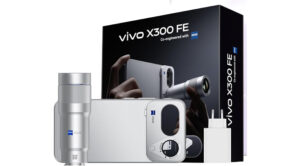
In 2026, the three Chinese flagships Vivo, Oppo, and Xiaomi converge on the same design: a phone body, a bayonet-mount dedicated teleconverter, and the historic optics brand printed on the barrel. The modular smartphone ceases to be a niche experiment. And the boundary with mirrorless cameras begins to blur.
For over a decade, the smartphone camera was marketed with a clever promise: everything in one device. Sensor, processor, lens, screen, storage, sharing — no need to carry anything else. Then something interesting happened. The Chinese started thinking the opposite: what if we put the camera body in our pocket, and a real lens in our bag? In May 2026, this idea stopped being a curious experiment and entered the market as a serious product. Three times in a row. Three different brands. Three European lenses with centuries of craftsmanship behind them printed on the barrel.
The situation is this. At MWC in Barcelona, Vivo presented the X300 Ultra with two bayonet-attachable teleconverters — a 200mm and a 400mm equivalent — by Zeiss, part of a “Professional Photographer Kit” developed in collaboration with SmallRig. On April 21, in a global launch, Oppo announced the Find X9 Ultra with the 'Hasselblad Earth Explorer Master Kit,” a 300mm telephoto lens with sixteen optical elements that mounts on top of the phone's 200-megapixel telephoto lens. And Xiaomi, which with the 17 Ultra He already has a 14-200mm triple Leica system, and is working with the Germans on a modular 100-megapixel Micro Four Thirds interchangeable sensor system that was previewed at MWC 2025. 16 Ultra The next generation, according to leakers, should also bring a true bayonet modular kit there.
Three flagships. Three historic brands. The same construction scheme. It's not a coincidence: it's the moment an industry has decided, all at once, that the modular smartphone makes sense.
A long history of failed attempts
It's important to remember this, otherwise all this enthusiasm seems naive. The history of add-on optics for smartphones is a rather bleak sequence of commercial failures. In 2013, Sony introduced the QX10 and QX100, two sensor-lens modules that attached to the phone via Wi-Fi: beautiful in reviews, unsellable at the counter. In 2014, Olympus released the AIR A01, a Micro Four Thirds cylinder that used the smartphone as a viewfinder. In 2015, DxO Labs launched the DxO One, a one-inch sensor to be attached to the iPhone's Lightning port. Hasselblad tried the same idea with the modular True Zoom for the Motorola Z in 2016. All projects disappeared within a couple of years.
The problem with that first wave was conceptual, not technical. Those products asked the photographer to bring a second camera body that replaced the smartphone sensor. It was a compact camera disguised as an accessory. It cost as much as a compact. It weighed as much as a compact. And in return, it offered a clunky workflow based on unstable Wi-Fi, dedicated apps, and connection delays. Anyone willing to carry all that around might as well have bought a real compact, or back then, an RX100.
This isn't the first time someone has tried to mount serious optics on a smartphone. It's the first time the system works because the optics don't replace the phone — they extend it.
The 2026 kits start from an opposing assumption. The main sensor is the phone's, already pro-grade, already with mature computational processing. The accessory isn't a disguised compact camera: it's an optical teleconverter that amplifies the reach of the already mounted telephoto lens. The Vivo X300 Ultra natively has a 200-megapixel 85mm equivalent; the 400mm Zeiss teleconverter adds optics without touching the sensor. The Oppo Find X9 Ultra has a native 230mm 10x optical zoom; the 300mm Hasselblad teleconverter mounts over the 70mm 200-megapixel lens and reaches almost 13x optical quality. It's an addition, not a replacement. And that's precisely why it makes sense.
The Vivo Road: constant escalation
Vivo arrived here first, and with a fairly precise path. The 2024 X100 Ultra was already a very serious Zeiss cameraphone, but the camera kit was third-party. The X200 Ultra, presented in China in April 2025, was the first to bring an official Professional Photographer Kit to the table, built by PGYTech, with a 2.35x Zeiss teleconverter that transformed the 85mm into a 200mm. It weighed 209 grams of glass and metal, and attached via bayonet to a dedicated cover. Reviews were cautious but surprised: it wasn't a gimmick, wrote Digital Camera World; it was stuff that stayed in the bag.
The X300 Ultra, announced at MWC 2026, has raised the bar. The new 400mm equivalent “Telephoto Extender Gen2 Ultra” is a true telescope. The old 200mm has been redesigned into a more compact version. Compatibility with the X300 Pro's bayonet allows for swapping optics between the two bodies – one system, two phones. An elaborate SmallRig video cage, physical controls on the cover (zoom ring, focus jog, REC button, mechanical shutter), and – this is the important part – the X300 Ultra will be available in global markets. Not just China.
Oppo Street the Hasselblad bayonet
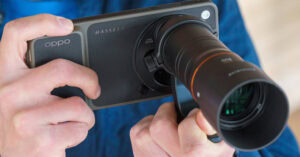
Oppo arrived in Spring 2026 with a more ambitious branding move. The Hasselblad Earth Explorer Kit isn't sold as a generic camera accessory – it's sold as an extension of the Hasselblad brand. The 300mm teleconverter explicitly draws inspiration from the design of the limited edition X2D II, with black metallic finishes, a textured bezel, and an integrated tripod ring. The phone also changes its look, with an organic grey-green and an orange “Canyon Light” that are clearly cellularized versions of the Swedish medium format aesthetic.
The workflow is slightly less fluid than Vivo's – you have to select a dedicated “Hasselblad Teleconverter” mode in the camera menu, unlike Vivo's on-screen toggle – but once you're in, you can navigate through 13x optical (300mm native), 30x, and 60x. The interesting thing is that the Hasselblad teleconverter works with the 200-megapixel 3x telephoto lens (70mm), not the 10x periscope lens (230mm). This choice is perplexing at first – why not enhance the longest focal length? – but it becomes clear when you look at the samples: the 200-megapixel sensor on the 3x telephoto is the best part of the camera system, and that's where the additional teleconverter truly adds quality.
The Xiaomi Way: the interchangeable sensor
Xiaomi is in a different strategic position, and it plays its cards more radically. It has already been working with Leica for years—the 17 Ultra from December 2025 features a triple system from 14-200mm with a 75-100mm APO certified by the Wetzlar-based company—and it even has a “Leitzphone” variant that puts the red dot directly on the body. But the big deal isn't the standard phone. At MWC 2025, Xiaomi presented a modular prototype much more ambitious: a block with a 100-megapixel Micro Four Thirds sensor and M-mount attachment, which magnetically coupled to the phone. Not a teleconverter: a second camera body that used the smartphone as a viewfinder and storage.
The 16 Ultra, expected in early 2026, should bring a simplified version of that prototype to production. If Xiaomi keeps its promise, the market will be faced with three parallel offerings and three different philosophies: Vivo is focusing on the optical extension of the integrated telephoto; Oppo is dressing up the same idea with medium format branding; Xiaomi-Leica is pushing further, towards a true interchangeable modular body. Three different answers to the same market question.
What does it mean for someone who already has a mirrorless camera?
Here's the editorial point, and I want to be honest: the phone isn't coming for photography in the strict sense, it's coming for the territory that the mirrorless still had after losing street and travel photography. The reach. The long focal lengths. The ability to zoom in on a subject at 400mm without a backpack. For years, a concert photographer who wanted to get a close-up of the singer from mid-hall had to carry a mirrorless camera with a 70-200mm or a superzoom lens. Now, a Vivo X300 Ultra with a 400mm teleconverter weighs less than a kilogram when mounted and fits in a jacket pocket.
This doesn't mean mirrorless cameras are dead. It means they are narrowing down to their historical role: the dedicated tool for those who do photography as a profession or with deep passion. The wedding photographer won't switch to a Find X9 Ultra. A professional wildlife photographer won't either—a 600mm f/4 remains a 600mm f/4. But the amateur photographer who wondered if they really needed to buy a Sony A6700 to take on vacation? That market is evaporating in real time.
Then there's the issue of optical branding, which is what I think should be looked at more seriously. Selling a “Zeiss” or “Leica” collaboration on a phone is, in essence, an exercise in borrowing credibility. Zeiss in China doesn't build Vivo's lenses: they define the specifications, supervise quality, and lend their name. Leica does the same with Xiaomi, and Hasselblad with Oppo. Is it enough to give the consumer the feeling that there's real optical heritage behind the lens? And perhaps - indeed, certainly - it is enough.
The border has moved
The question is no longer “smartphone or camera.” The question is “what camera is my smartphone this month, and what else do I really need to carry around.” For many photographers, the answer changes: less is needed. For others, nothing changes — the 67-megapixel RAW file from the Sony A7R VI announced two weeks ago There's another planet. But for the broad middle segment, 2026 marks a shift in the center of gravity.
I say this without nostalgia and without panic. I grew up convinced that the dedicated camera body was the only serious way to do photography. I still think so, for certain jobs. However, observing three Chinese flagships converge on the same modular intuition, with three historic optical brands sealing it, forces me to recognize that the boundary has been shifted not by a single revolutionary product, but by an industry decision. When Vivo, Oppo, and Xiaomi converge, it means they have seen a market. And when Zeiss, Hasselblad, and Leica all head in three different directions above that market, it means they have legitimized it.
The most honest thing we can do, as photographers, is not to defend territory already lost. It's to look ahead and ask ourselves what we're really looking for when we pick up a camera and press the shutter. If the answer is “a beautiful photo,” the modular phone of 2026 will give it to us. If it's something else — a certain relationship with the tool, a certain slowness, a certain physicality of the gesture — then perhaps that was already the real reason we were buying mirrorless cameras. And no 400mm Zeiss teleconverter can take that pleasure away from us.
 Italian
  English
  German
  French