
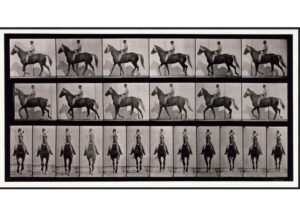
From frame to motion: how photography became video
Every video we watch today—whether it's a movie in the cinema or a Reel on Instagram—is based on a simple visual “trick”: Movement doesn't really exist. A video is nothing more than a sequence of many photographs taken one after another and projected so quickly that our brain cannot distinguish them individually, merging them into a fluid scene.
But how did we go from the first still photograph to the magic of moving pictures?
1. The Galloping Horse Bet (1878)
It all began with a debate among horse racing enthusiasts: When a horse gallops, do all four hooves ever leave the ground at the same time? With the naked eye, it was impossible to understand.
To solve the mystery, the photographer Eadweard Muybridge positioned 24 cameras along a track, connected by wires. When the horse passed, it pulled the wires and took photos in rapid succession. Not only did he settle the bet (yes, all four hooves leave the ground!), but by showing those images in rapid sequence he created the first photorealistic animation in history.
2. The Flexible Film and the Kinetoscope
Before the 1890s, photographs were taken on heavy, rigid glass plates. The decisive invention was the celluloid film (a flexible, transparent plastic tape), developed by George Eastman (founder of Kodak).
Thanks to flexible film, Thomas Edison and his assistant William Dickson invented the Kinetoscope: a large wooden box in which the film ran continuously in front of a light bulb. The viewer looked inside through an eyepiece and could watch short clips lasting just a few seconds.
3. The Lumière Brothers and the Birth of Cinema (1895)
The Kinetoscope had a limitation: it could only be used by one person at a time. In Paris, the brothers Auguste and Louis Lumière they had the winning idea: to apply the projector principle of the “magic lantern” to photographic film.
In December of 1895, they organized the first public, paid screening in history. They projected short films (such as The release from the Lumière workshops e The arrival of a train at La Ciotat station). For the first time, an entire audience shared the experience of seeing reality in motion.
The Secret of “Frames Per Second” (FPS)
For a video to appear smooth, the human eye needs to see at least 12–16 different images per second.
-
Standard cinematic established the speed at 24 frames per second (Frames per second).
-
Modern videos on smartphones or TVs travel at 30, 60, or even 120 FPS.
In summary: the transition from photography to video was not the invention of a completely new technology, but rather the acceleration of photography itself.
 Italian
  English
  German
  French