
Canon today presents the EOS R6 V, without a viewfinder. Sony follows thirty minutes later. The viewfinder—the foundational gesture of modern photography—is quietly exiting the cameras of tomorrow, and with it, a certain way of looking at the world.
I'm writing this, with only a few dozen minutes left before the announcement. 3:00 PM on an ordinary Wednesday in May will, shortly, become a small crack in the geology of photography: Canon will present the EOS R6 V, and half an hour later Sony will pull its A7R VI out of its hat.
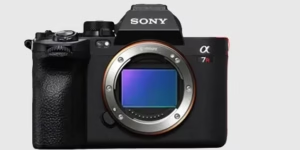
It's rare for two giants to make announcements on the same day, at the same time—even rarer for them to do so to declare, each in their own way, the same thing. The viewfinder has become an accessory. In fact, in some cases, it's an absence.
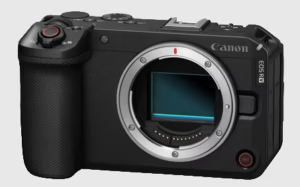
The R6 V, for friends, is a 598-gram flat box with a 32.5-megapixel full-frame sensor, an integrated cooling fan, 7.5-stop IBIS, and one omission that outweighs all its features: no viewfinder. The articulating screen remains, the EVF is gone. It will cost around $2,499, a few hundred less than the just-released R6 Mark III, and will arrive in stores in June. It is, essentially, Canon's answer to the Sony FX3—the camera that since 2021 has caused independent filmmakers to stop calling themselves photographers.
It's not an isolated incident. Nikon paved the way a few months ago with the ZR — same philosophy, big, bright screen, period, no viewfinder. Sony, which unceremoniously captured the creator video market with the FX3, has been sitting on the throne of this revolution for four years. Today's announcement is the official declaration: the Tokyo-based company that was still resisting — Canon, which until yesterday promised glass viewfinders and faith in the eyes — abdicates.
For the first time in one hundred and fifty years, a serious camera can be built without asking the eye where to look.
The dark room he carried around
When I was a few years younger and my eye was always glued to the viewfinder—plastic, then pentaprism, then electronic—I thought it was a matter of precision. You see better this way, up close, isolating the frame from the rest of the world. But then I realized the viewfinder wasn't an optical instrument. It was a room.
It was a small box of darkness into which the photographer would retreat each time, for a few seconds, to decide what existed. Everything else—the traffic noise, the people passing by, the friend waiting for you—remained outside. You took the picture by yourself, inside a black bubble as long as an inhale. The viewfinder wasn't so much for framing: it was for extracting the photographer from the world for the time needed to select a portion of it.
The screen, even the brightest, even the sharpest, doesn't do that. The screen is exposed, social, shared: everyone can see what you see, because you see it at arm's length from your body and not a millimeter from your eye. We shoot in public, now. We shoot with outstretched arms. We shoot — let's face it — like we take selfies.
 Italian
  English
  German
  French