
For five years, Valerio Minato calculated the rise of a full moon behind the Milan skyline. On May 2nd, from sixty-five kilometers away, he saw it arrive. With an unplanned event that the plan couldn't contain.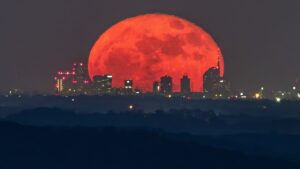
There are photographs you take and photographs you wait for. Valerio Minato's photograph from May 2nd belongs to the latter category – the rarer, more stubborn one. Five years of calculations, a dozen failed attempts, and a red disc that finally rises exactly where it should: behind the UniCredit Tower, above Milan, as seen from Nebbiuno, on the hills overlooking Lake Maggiore.
The idea was born in 2021. Minato – a photographer from Biella, born in 1981, who had already become a minor internet cult figure for his Turin alignments between the moon and the Mole Antonelliana, or between the Matterhorn and the Basilica of Superga – began studying the only possible position to frame the satellite at the exact moment it rises, perfectly centered on the skyscrapers of Porta Garibaldi. On paper, it seems like a geometry exercise. In practice, it's an obsession.
There are too many variables to keep track of; just one wrong one can make everything fail. The observation point must be about sixty-five kilometers as the crow flies—that's the distance that allows the telephoto lens to compress space and render the moon disk as large as a city. The horizon must be perfectly clear, because the moon, unlike the sun, doesn't pierce through haze: the moon reflects, and a layer of humidity is enough to turn the disk into a confused halo. The full moon must coincide with a time when the sky is still dark enough to hold contrast. And then there's the Earth's curvature, which at that distance is no longer a footnote for the astronomy manual: it's a factor requiring millimeter-level compensation.
Minato works on these variables from the Ivrea Greenhouse and from the heights above Lake Maggiore, shifting the observation point a few kilometers at a time, replicating attempts based on lunar ephemerides. At least a dozen, he says himself. The last failed attempt was on May 1st: the evening before the successful shot.
«My crazy idea took shape: an immense fiery red disc emerged from the horizon to pass exactly behind the Porta Garibaldi skyscrapers.»
— Valerio Minato
When Minato triggers the machine from the Nebbiuno hills on May 2, the plan works. The red disc rises into the right position, aligned with the UniCredit Tower as calculated. But the calculation hadn't accounted for two things. The first: a little to the left of the CityLife towers, crowning the scene, appears the Duomo's Madonnina, an apparition the photographer hadn't included in the script. The second, even more audacious: while the shot is being taken, a Ryanair Boeing 737-800 – flight FR8326, which departed from Malpensa for Budapest – crosses the lunar disc. A framing that no trigonometry could have guaranteed.
Anatomy of an Alignment
- Photographer
- Valerio Minato (Biella, 1981 — operational base Turin)
- Data
- May 2, 2026, at moonrise
- Trigger point
- Hills of Nebbiuno (NO), above Lake Maggiore
- Distance to subject
- ≈ 65 km as the crow flies
- Years of planning
- 5
- Previous attempts
- At least 12
- Declared target
- Alignment with the UniCredit Tower
Minato's images have been circulating for a few years with a regularity that might seem miraculous to outsiders: the moon perfectly positioned behind the Mole Antonelliana, an aurora perfectly behind Monviso, the Matterhorn perfectly behind Superga. These are photographs that the public perceives as moments of luck, but which are in fact the exact opposite of luck. They are the visible result of invisible work involving ephemerides, maps, planning software (PhotoPills, The Photographer's Ephemeris, and the like), failed outings, waiting in the car, and early morning ventures in the cold.
Urban landscape photography lives in a strange balance. You work for years to control every variable, and then you wait for something unexpected—a plane crossing, a cloud moving aside, a small Madonna appearing from a distorted perspective—to deliver the finishing touch. The part you plan is what makes the shot possible. The part you don't plan is what makes it memorable.
The part you plan makes the shot possible. The part you don't plan makes it memorable.
There's a small lesson in all of this for photographers. It applies to the moon over Milan just as it does to any other subject that refuses to stay still. Talent here isn't about pressing the button at the right moment: it's about having created the conditions for that moment to present itself, sooner or later. And then having the patience to return the next evening, and the evening after that, until patience is rewarded.
Minato is now already at the next alignment, I imagine. Somewhere on the map there's a line connecting an unknown hill and an ordinary city, and a date on the lunar calendar that he has already circled. When the next definitive shot comes, we'll see him circulate on social media for three days, we'll save it to our phones, we'll rewatch it with the feeling that someone It can do something that most of us can't even imagine. And it will once again be a photograph that took itself, after five years of work.
 Italian
  English
  German
  French