
Sunday, May 17th, 7:10 PM. Jannik Sinner defeats Casper Ruud 6-4, 6-4 on the Centre Court of the Foro Italico. For one photographer, it's the frame that closes a circle opened in 1976: the line of telephoto lenses on the sidelines had been waiting for the same scene for half a century.
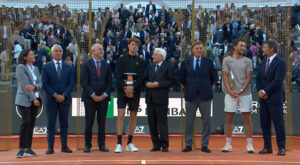
There are matches that are worth it for what happens on the court and others that are worth it for what they do to the photographers. Sunday's match at the Foro Italico clearly belonged to the second group. When at 7:10 PM Casper Ruud sent the last forehand into the net and Jannik Sinner collapsed on the red clay with that familiar composed look of disbelief, the entire row of telephoto lenses on the barrier by the court rose at once. Fifty years of waiting had built up that moment even before the match point actually arrived.
From home, in front of the monitor, I did what anyone who watches tennis with a photographer's eye does: I followed the reactions of my colleagues courtside more than the ball. It's their hands that tell you when history is being made. And at Center Court yesterday, hands were not still for minutes—because it wasn't just a title, it was the alignment of a legend.
The photograph missing from the album
The last time an Italian had won the men's singles at the Foro Italico was in 1976. Adriano Panatta. We know what he wore, we know the cigarette, we know the Adidas shoes and the bowtie, we know above all that one black and white image that opens or closes every Italian tennis biography. But we also know another thing very well: in half a century that photo has worn out. It has been printed too many times. It has become an icon and therefore a cliché.
Yesterday our collective album finally gained the next page. It doesn't replace Panatta's page—he was already sitting in the stands, a direct witness to the passing of the baton—but it complements it, updating its meaning. Now there exists a diptych: 1976, 2026. Two portraits that tell us what Italian tennis è state and what it is today.
The Roman crowd knows how to recognize who steps onto the court with character, and yesterday Sinner took over the entire Center Court.
— The echo of Panatta in the stands, after the match
A telephoto lens in Rome captures subjects from a distance. This often means isolating details of famous landmarks like the Colosseum or St. Peter's Basilica, compressing perspectives to make distant buildings appear closer, or candid shots of people without them noticing. It's ideal for emphasizing architectural details, capturing dramatic cityscapes, or getting close-up portraits in busy public spaces.
The Centrale at the Foro Italico — the current one, inaugurated in 2010 from a design by Angelo Zampolini — is an almost perfect setting for sports photography. Steel, crystal, marble, reinforced concrete: a mineral box open to the sky, with steep stands that create natural depth of field, and a clay court that at 7 PM on a Roman May evening turns a very warm orange. For those shooting from the sidelines, it's a gifted light.
And it is precisely this light that served as the backdrop for Sinner's exultation: the sun setting behind the upper tier, the oblique shadow cutting diagonally across the court, the audience silhouetted against the light. The agencies, in the following hour, distributed very similar shots – not because those who were there lacked imagination, but because certain geometries call to you. When a champion kneels with an arm outstretched to the sky and an arena embraces them from top to bottom, you have two seconds to capture the composition, and everyone goes for it.
The most underrated moment, and in my opinion the most photographically interesting, came shortly after. Sinner signed the camera with his marker – a ritualistic gesture by now – and turned towards his box. That's where the photo I was really interested in was taken: the handshake with his team, the faces of those realizing only in that second what had just happened. It's the non-heroic photograph, the one that lasts. Everything else is a poster.
The Passing of the Torch, in Two Portraits
Adriano Panatta was in the stands. I couldn't photograph him – I wasn't there, I'm writing from my desk as I always do – but the images that came out from the agencies did a job worth mentioning: most photographers looked for the double glance. Sinner raising the cup, Panatta applauding. Sinner turning towards his box, Panatta turning towards his wife. It's the mental montage that sports photojournalism does best: two frames on a page, and fifty years of Italian tennis are compressed.
Sergio Mattarella was also in the stands, as he was last May for Jasmine Paolini's final. His presence is now another element of Rome's iconography—the President clapping composedly is a service image that the agencies produce every year, but it works because it adds a civic register to the sports chronicle. A flag without rhetoric.
What remains, and what will I print
The photographs destined to last from today, in my opinion, are three—and none of them is the obvious one of triumph. The first: Sinner on his knees, arms wide, the shadow of his body cast on the court, seen from above the press tribune. An almost religious geometry. The second: the dedication on the glass with the marker—the low, intimate gesture, an anticlimax. The third, and this is the one I really want to hang: the handshake with Ruud, two exhausted players, the net in between like a thin boundary between the winner and the loser. It is there that tennis is still the most photogenic of individual sports.
Starting Monday, the tour moves to Paris for the Roland Garros qualifiers. The lights of the main court go out. The red clay, marked by the shots from an hour and forty-five minutes, remains — that too, seen up close, is a photograph. Perhaps the most honest of all.
 Italian
  English
  German
  French