
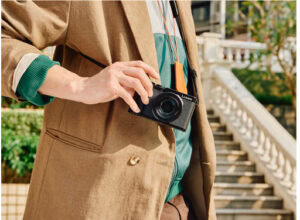
For Lumix's twenty-fifth anniversary, Panasonic announces the L10: Leica 24-75 f/1.7-2.8 zoom, a Four Thirds sensor, and a detail that sounds almost political today. It kept the EVF. While everyone else is removing it.
The news arrived mid-last week, and I read it in the time it takes to finish a coffee. Panasonic, to celebrate twenty-five years of the Lumix brand, announced the L10: a fixed-lens compact camera with a Micro Four Thirds sensor and a 24-75mm f/1.7-2.8 Leica zoom. On paper, it's an update – one of many – to the LX100 family, the last of which was released in 2018. But the reason I stopped to read its specifications with some interest is a line that appears midway through the press release. The L10 has u
In the viewfinder. A 2.36 million dot OLED, nothing esoteric. And yet, in 2026, it's news.
A choice that weighs more than its size
I realize that saying it like this sounds almost ridiculous. A viewfinder in a new camera? So what? Yet context is everything. On the same day as the L10's announcement, May 12th, Canon and Sony lit the fuses for the 13th: Canon presented the EOS R6 V—a camera body derived from the R6 Mark III that had its EVF surgically removed, replaced by an internal fan for video. Sony announced the a7R VI with a monstrous 9.44 million dot viewfinder, but aimed at a professional audience who will probably use it half the time, opting for the articulated display the rest of the time. Panasonic itself, twelve months ago, had launched the S9—its full-frame compact—without a viewfinder, sparking a small earthquake among purists.
So if today, on the L10, the EVF remains, it's not out of inertia. It's a choice. Panasonic's own press release, between the lines, implies this: the viewfinder is described as a statement of intent, not a concession to the past. A small editorial statement embedded in a technical sheet.
The eye that still watches
There is a precise geometry in the gesture of bringing the camera to the eye. The arms close against the body, the shoulder becomes a tripod, the other eye remains open and reads the world around the frame. It's an ancient gesture—Cartier-Bresson, Salgado, but also your aunt with her Olympus mju II—that says something non-trivial: that photography is first and foremost an act of seeing, not an act of showing. The viewfinder closes the photographer inside a small dark rectangle where only the composition exists. Everything else, for an instant, ceases to exist.
The articulated screen is another thing entirely. It's useful, it's convenient, but it's the shot of the director, the content creator, the parent filming the child while holding the phone at arm's length. It's a shot without intimacy, in which the photographer continues to see the world around the scene, and the scene becomes just one window among many, a flat surface on which a finger can act. I'm not saying one is better than the other. I'm saying they are two different ways of taking photos, and that removing the viewfinder—as many are doing—means choosing one of them and archiving the other.
The grammar of the LX100
The L10 isn't born out of thin air. It's declaredly the heir to the LX100, released in 2014, and the LX100 II from 2018. The formula remains substantially unchanged: a Leica 24-75 f/1.7-2.8 zoom, a Micro Four Thirds sensor with a multi-aspect design, an aperture ring on the lens, and an aspect ratio selector built into the barrel. These are tactile – mechanical – details that concern how the hand interacts with the camera even before the eye engages with the scene.
The effective resolution increases from 12.8MP (LX100) to 17MP (LX100 II) to 20.4MP of the L10, with a total sensor of 26.5MP — the same as the GH7. The autofocus shifts from contrast-detect to a 779-point phase-hybrid system, with recognition of eyes, faces, bodies, animals, vehicles, and — a new and telling category — “urban sports.” Video reaches 5.6K 60p, DCI 4K 120p, V-Log with real-time LUTs. Beneath the saffian leather and anodized aluminum, the 2026 camera is a different creature. But the steering wheel is exactly the same. And that's the point.
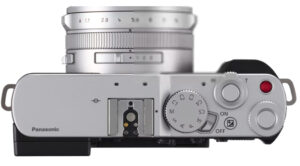
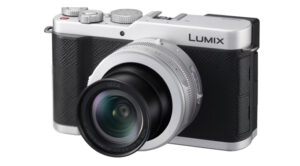
- Sensor
- 4/3" BSI CMOS, 26.5MP total / 20.4MP effective (multi-aspect 4:3, 3:2, 16:9, 1:1)
- Objective
- Leica DC Vario-Summilux 10.9-34mm (24-75mm equiv.) f/1.7-2.8, manual aperture ring
- Viewfinder
- 2.36 million dot OLED
- Display
- 3" free from 1.84 million points, with rotating vertical UI
- Autofocus
- Phase Hybrid, 779 points, AI subject recognition
- Gust
- 30 fps (electronic shutter) / 11 fps (mechanical)
- Video
- 5.6K 60p open-gate, DCI 4K 120p, V-Log, 4:2:2 10-bit
- Stabilization
- Power O.I.S. (no IBIS)
- Macro
- 3 cm at wide-angle
- Body
- Magnesium alloy, saffiano finish, 508 g
- Price
- $1,499 USD (Black/Silver) · $1,599 USD (Titanium Gold Special Edition)
- Availability
- June 2026 (estimated shipping: June 17)
No-mind
Panasonic has wrapped the announcement in a philosophy — “Shaping Emotions,” Mushin, No-mind, which in Japanese translates roughly to “empty mind,” the Zen state of pure presence, without interference. It's marketing, of course. But it's marketing that says something interesting. The added value here isn't the technical specification: we know the sensor from the GH7, the zoom has a decade-long lineage, and the processor comes from the S1 II. What Panasonic is selling isn't a camera, it's a way of photographing. Tactile, physical, slow enough, with the eye glued to the body.
It's a positioning. And in a market that has been shouting “creator” at every keynote for three years, it's almost a counter-thesis. The Titanium Gold Edition—$1,599, limited run, leather strap, gold lens cap, gold-toned menus—is just the icing on the cake. The cake is the viewfinder.
What the machine does not say
There are still some gray areas, it must be said. The L10 doesn't have in-body stabilization — only optical Power O.I.S. on the lens — and in a premium compact from 2026, that sounds like a step back compared to the competition. A headphone jack is missing, a detail that matters for those who intended to use it as a secondary video camera. The Four Thirds sensor structurally limits bokeh and high-sensitivity headroom, and at $1,499, it dangerously approaches the territory of the Fujifilm X100VI or the Leica D-Lux 8 — tough competitors, each with its own arguments, some with larger sensors.
None of this, however, shifts the narrative. The narrative is the EVF. The narrative is that, while the industry is convincing photographers that the viewfinder is a relic of the past, a Japanese company decides the opposite. And it says so quietly, at the bottom of a spec sheet, between the number of autofocus points and the weight of the camera body.
A small vision policy
Perhaps I'm exaggerating. Perhaps it's just another premium compact, and in twelve months it will be surpassed by the next one, and then the one after that. But from behind this desk, reading press releases from mid-May one after another—Panasonic on the 12th, Sony and Canon on the 13th, all within the same forty-eight hours—I felt like I saw three diverging paths that divide photography into factions. Sony pushing technology to the limit. Canon surrendering to video. Panasonic planting a flag.
The L10 won't save the viewfinder. It probably isn't even meant to. But it reminds—for those who will buy it, in June, for $1,499—that photography still begins with one eye open and one closed. It's little. It's everything.
Looking through is not obsolete yet.
 Italian
  English
  German
  French