
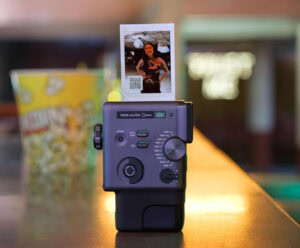
Fujifilm dusts off the 1965 Single-8 aesthetic, stuffs a five-megapixel sensor and a time-travel dial inside it. Four hundred euros to pretend to be a moviemaker from the last century. And maybe that's the whole point.
Every now and then, a small philosophical question hides within a press release. The Instax Mini Evo Cinema arrived on the global market at the end of January, but it's only now—with the “long” reviews finally filtering in and a handful of YouTube videos where Gen Z kids handle it with a reverence worthy of a daguerreotype—that the device is beginning to reveal what it truly is. And what it truly is isn't a camera. It's an act of commercial archaeology.
The technical specs are almost embarrassing: a 1/5-inch sensor, five megapixels for photos, 600x800 pixel video at 24 frames per second, a battery that lasts just over a day only if you hold your breath, a list price of four hundred and nine dollars. On any imaging spreadsheet, this device falls below the threshold line. Even a forty-euro IKEA webcam has more pixels.
Yet the reviews—the real ones, written by people who actually held the machine in their hands for weeks—converge on one adjective that you don't often read in gear tests: Funny. PCMag gave it their Editors’ Choice, describing it as “one of the strangest machines we've tested in fifteen years.” Tom's Guide included it among the best instant cameras of 2026. Even those who pan it—and there are fierce pans, chief among them The Phoblographer for its connection bugs and battery issues—pan it with a certain affection. You don't pan a machine like this; you scold it, like a friend who's gone too far.
The thing, first of all
What exactly does the Instax Mini Evo Cinema do? Four functions in one body. It takes digital photos, records fifteen-second clips (extendable to thirty via app), prints instant photos in Instax mini format, and—the feature that drove social media crazy—adds a QR code to the printouts that links to the video. Print a birthday scene, scan the print with your phone, and the clip starts playing. It's the physical version of a TikTok watermark. It's the Remember that you must die. reported in its opposite: the press that contains movement.
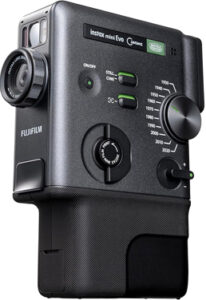
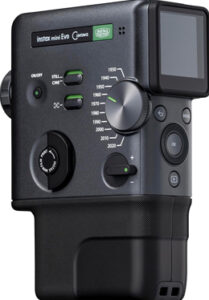
It's held vertically, like a pistol. Above is the optional external viewfinder that turns the rear screen into an electronic viewfinder. On the side, there's a lever for printing that mimics film winding. Each movement is a quote from another movement, another era, another machine. It's a device that doesn't want to be used; it wants to be impersonated.

The time knob
The flagship feature is called Eras Dial, and it is — let's say it right away — a brilliant marketing operation disguised as an algorithm. It's a dial that applies “vintage” filters to photos and videos, spanning ten decades from 1930 to 2020. Grain and pallor for the Thirties, full saturation for the Eighties, cool and defined chroma for the present. Each decade is paired with the Degree Control Dial to adjust contrast, noise, and color — up to ten variations per era, one hundred total combinations.
Some effects even add the mechanical noise of the projector as it spins. The sound of home cinema like Sound design. We are simulating the memory of the sound of something that many users, statistically, have never actually heard.
Here's the first layer of dizziness. The machine doesn't emulate an analog aesthetic: it emulates the idea an analog aesthetic, as experienced by a twenty-something who has seen “sixties” films shot in the 2000s. The 1930s grain of the Mini Evo Cinema is not 1930s grain. It's the 1930s grain as we remember it, after having seen Babylon by Damien Chazelle.
It doesn't emulate an analog aesthetic: it emulates the *idea* of an analog aesthetic. The grain of the 1930s isn't the grain of the 1930s. It's the grain of the 1930s as we remember it after seeing Babylon.
The Single-8, or the ghost of Fujifilm
The object to which this machine claims to pay homage is the Fujica Single-8 P1, launched by Fujifilm in April 1965. It's a detail worth remembering because Single-8 is one of the most interesting lost formats in the history of amateur filmmaking.
1965 was the year of the great 8mm challenge. Kodak launched the Super 8 with a coaxial cartridge, and Fujifilm responded with the Single-8, which housed two reels on the same plane and—above all—incorporated a metal pressure plate in the camera instead of the plastic cartridge. On paper, it was a technically more refined system. It allowed for unlimited rewinding. In theory, it guaranteed superior film flatness.
It worked very well in Japan, where it captured eighty percent of the home movie market until 1973. It worked very poorly in the rest of the world, where Kodak's ubiquity crushed the format. Fujifilm continued to produce Single-8 film until 2012. It's a format that truly existed, had its enthusiasts, its dedicated magazines — there was even a Japanese monthly titled “My Single-8” which published from 1965 to 2012 — and then disappeared almost without a whisper.
When Fujifilm today takes a four-hundred-euro digital camera and gives it the form of a 1965 P1, it is performing an operation of selective memory. It is claiming a heritage that most buyers not only do not know—they don't even imagine it could exist. It's as if Olivetti, ten years from now, were to launch a smartphone with the design of the Programma 101.
Technical Sheet / Instax Mini Evo Cinema
- Sensor
- CMOS 1/5"
- Photo resolution
- 5 megapixel
- Video resolution
- 600x800 px at 24 fps
- Clip duration
- 15 sec (30 sec w/ app)
- Objective
- 28mm equivalent prime
- Effects
- 10 hours × 10 variations = 100 looks
- Instax Mini Film
- Connectivity
- Bluetooth + Wi-Fi (instax mini Evo app)
- Battery
- ~125 shots per cycle
- List price
- $409 USD / £329 GBP (~€380)
- Global launch
- January–February 2026
- Stated inspiration
- Fujica Single-8 P1 (1965)
The price as an argument
Four hundred and nine dollars for five megapixels is the real scandal here, and also its key. The price is what separates the Instax Mini Evo Cinema from a scam and qualifies it as position. For four hundred euros, a rational consumer would buy an Osmo Pocket 3 with a one-inch sensor — it costs thirty dollars more. They would buy a used Sony A6000 with a kit lens and get a mirrorless camera with phase-detection autofocus. Alternatively, they would buy six Polaroid Now sessions for the Saturday nights of the year.
Instead, someone who buys the Instax Cinema is buying something else. They are buying an aesthetic alibi. A stance. The right to take bad photos, by choice. It is — and here finally comes the philosophical question of the press release — the first digital camera that charges for poor quality as premium feature.
It's a mechanism that photography knows well: the Holga, the Diana, the lomographies of half a century. Poorly made plastic cameras, sold with light leaks, fierce vignetting, and blurs. But with one fundamental difference: the Holga was cheap because it was truly poorly made. The Instax Cinema costs four hundred euros. to simulate to be made wrong. It is the fake vintage brought to its logical conclusion.
What are we really buying
The short answer is: time. More precisely, a time that we don't own. The Mini Evo Cinema sells to a twenty-something the chance to shoot a summer that resembles—in filter, grain, and duration—the summers we see in movies. Those Super 8s of grandparents dancing on the beach, 1950s weddings, 1970s hippie parties. Collective memories of people who weren't there.
And here the device becomes interesting for those who, like us, try to observe visual culture without being crushed by cynicism. Because there is something touching about this hunger. A generation that has had a camera in its pocket since birth, and has cataloged its every step in 12-megapixel HDR on iCloud, is spending money to get images worst. Dirtier. More limiting. Fifteen seconds, that's all. One hundred combinations, that's all. One physical print, just one. The QR code is the compromise, a nod to the twenty-first century: but the basic gesture is to reduce a burden, not to add to it.
It is—paradoxically—an act of resistance against excess. I make a renunciation. material precisely, resolution, duration, choosing a device that I obliges. The machine becomes the discipline that the photographer can no longer impose on himself. Grain is a gymnasium.
A prediction, and a caution
I bet the Instax Mini Evo Cinema will sell well, actually very well, and that in eighteen months we'll see a special cream-colored edition, a collaboration edition with some fashion designer, perhaps a “seventies” edition with a faux leather print lever. Fujifilm has tapped into a cultural nerve and is tickling it with surgical precision. The nerve is the melancholy of digital natives for an analog era they've never experienced.
The caution is simple: this is not a photographer's purchase. It's a purchase for person who has a special relationship with time. If you enjoy making images—in the true sense, of looking at the world and translating it—then the Mini Evo Cinema is a distraction disguised as a tool. If, on the other hand, you're interested in the ritual, the object, the pose, the small gesture of carving out fifteen seconds of your day and then printing them on a postcard—then this is the most honest machine you could buy. It knows exactly what it's selling, and it tells you that in the name itself. Mini. Evo. Cinema. Three words, three good lies, one truth.
Fifty years after the P1 in 1965, Fujifilm still sells film. It's just that now the film lasts fifteen seconds, prints on a postage stamp, and needs to be framed with a phone to be seen. That's modernity, my old friend. It couldn't have gone any other way.
You can purchase it on our website: https://photoworld.it/product-category/store/macchine-fotografiche/
 Italian
  English
  German
  French