
Sony World Photography Awards 2026: Slow Gaze Wins (and Italy Enters St. Peter's)
In London, 430,000 images were awarded, but the ones that remain are the most patient. Citlali Fabián is the Photographer of the Year for work done through listening. And in St. Peter's Square, two Italian photographers saw something that couldn't be seen on television.
There are years when photography awards seem to compete to see who can shout the loudest. Then there are years—rare, to be sure—when one gets the impression that the jury decided to turn down the volume and award those who remain still. 2026 is the year of Sony World Photography Awards It's one of these. And I don't know if it's a coincidence or if photography, deep down, is trying to catch its breath again.
The ceremony was held in London on Thursday, April 16th, the nineteenth edition of the competition organized by the World Photography Organisation. The numbers, as always, are staggering, to which we have become accustomed: over 430,000 images submitted from more than 200 countries. Just speaking of the matter: even if one wanted to watch them all at the rate of one per second, without ever sleeping, it would take a good five days. But it's not the numbers that interest me, this time. It's the type of photography that won.
The facts in brief
- Edition
- 19th — Sony World Photography Awards 2026
- Ceremony
- April 16, 2026, London
- Registrations
- Over 430,000 images from 200+ countries
- Prize money
- $25,000 for the Photographer of the Year
- Photographer of the Year
- Citlali Fabián (Mexico) — Bilha, Stories of my Sisters
- Outstanding Contribution
- Joel Meyerowitz
- Show
- Somerset House, London — April 17 / May 4, 2026
The winner who doesn't photograph herself
The most coveted title, that of Photographer of the Year, he went to Citlali Fabián, Mexican visual artist born in the indigenous Yalalteca community, now based in London. The project is called Bilha, Stories of my Sistersa series of portraits, accompanied by digital illustrations, dedicated to indigenous women from Oaxaca who, in various fields—law, linguistics, art, ecology—are doing things for which, in thirty years, someone will say, “It's a shame we didn't notice them sooner.” Fabián wanted to notice them now.
The method is what makes the difference. Fabián doesn't go, he pounces and leaves. He builds the portrait together alla persona ritratta, ne fa una co-autrice. “I miei soggetti non sono semplicemente fotografati — ha detto Monica Allende, presidente della giuria professional — they are active participants in how their stories are told“. It's a statement that seems obvious, but within the history of documentary photography, it's almost subversive. It means: The photographer is no longer the hunter. He is one who sits, waits, and listens. This year, the idea that authorship is shared is winning.
Italy on the podium: two looks inside a square
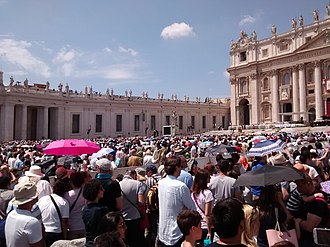
And now let's talk about us, because the news — for an Italian photography media outlet — is twofold. In the category Portraiture, which for many is the heart of the competition, won an Italian job: The Faithful, signed by the couple Jean-Marc Caimi and Valentina Piccinni. Long-time photographers, published everywhere — from Guardian a The Mirror, da The World a Internazionale — they did something that only those living in Italy could truly do: they went to St. Peter's Square in the days between Pope Francis's death and the election of his successor, and instead of aiming the car at the balcony, they turned it towards the crowd.
The result, from what I've read in the jury's descriptions and the few circulating images, is a collective portrait that has much more of fandom than liturgy. Pilgrims, tourists, people in tears, people with their smartphones held high, people who don't quite know why they're there but are present. In a week when television showed the same shot—fixed camera, closed balcony—Caimi and Piccinni photographed the only thing truly worth photographing: the faces of those waiting. It's photography that does what journalism sometimes can't: turn the chronicle into a face.
And it doesn't end here, because among the Italian awardees there are also three other names worth keeping an eye on:
- 1st place medal
Jean-Marc Caimi & Valentina Piccinni— Portraiture (winners)The Faithful Crowd at St. Peter's between Francis and the new Pope
- Silver medal
Matteo Trevisan— Environment (2nd place)Recognition in a category that is increasingly central to contemporary photographic debate
- Bronze medal
Federico Borella— Portraiture (3rd place)Documentation of the Koryo-saram community in Uzbekistan and its rediscovery of identity through the K-Wave
- Bronze medal
Daniele Vita— Still Life (3rd place)An Italian presence in one of the most difficult categories to interpret today
Four Italians among those awarded in the professional categories. This doesn't happen every year, and in fact, for those who have been following these competitions for a while, it's surprising. I don't know if it's a particularly good season or if, quite simply, we are learning to submit more thoughtful and less spontaneous projects. I lean towards the second hypothesis. I would like that.
What photograph will win this 2026 award
If I read the list of winners—Fabián for listening, Caimi and Piccinni for the crowd, Santiago Mesa for a long investigation into Colombian communities within the coca economy, Isadora Romero for a “manual on how to build a forest,”, Todd Antony for the Buzkashi Afghan — I find a thread that interests me to follow.
None of these projects are stock photography in the classic sense. None are “I arrived, I shot, I left.” They are all works that imply timemonths, sometimes years, spent in a place and with a community. And they are works in which the author agrees not to be the main voice, but the sound box of voices that without him would not arrive. It is a photograph that has stopped being primarily aesthetic and has begun again, with a lot of stubbornness, to be ethics.
(Parenthetically: the lifetime achievement award — Outstanding Contribution to Photography he went to Joel Meyerowitz, someone who knows more or less everything there is to know about patience on the field and long games. I don't think it's a coincidence. Juries send signals through these awards as well. This year, the signal seems clear to me: Slow down.
Where to see it
The works are exhibited at the Somerset House in London From April 17th to May 4th, 2026: over 300 prints plus hundreds of images on digital displays, with a special section dedicated to Meyerowitz. If you're in London during these two weeks, it's a visit that will likely be worth more than any online masterclass.
For those who haven't figured it out, the winners' selections are online on the World Photography Organisation's website. I took a look at the portraits of The Faithful I've already done it, and I had that rare feeling—when you look at a photo and think: Anyone could have done this, but they did it.. And that's the difference between those who win an award and those who don't. Nothing else.
 Italian
  English
  German
  French