
One hundred fifty grams above San Gimignano under the snow, and a revolution that is barely felt: with this, composition is no longer decided in front of the subject, but in front of the timeline. For those who do photography, it's a watershed moment disguised as a gadget.
I spent the afternoon thinking about it. And I realized that the most interesting thing isn't what made the room applaud — the video quality, the portability, the hundred euros a year for the policy. The most interesting thing came a few minutes later, when Biagini brought out the Avata 360. And there, without warning, something in the photographer's craft changed.
01 / The 250-gram thresholdWhen flight becomes a gesture
Let's start with the boring part, because it's what explains why we ended up here. Under 250 grams, In Italy, a license is not required: registration on D-Flight costs six euros, a QR code attached to the shell, a policy often already included in household insurance, and you can take off. Free zone. Visual flight. No one asks who you are.
The Neo 2 weighs one hundred fifty-one grams. Half-inch CMOS sensor, 4K at 60fps, 4K slow-motion at 100fps, omnidirectional sensors with front-facing LiDAR, new two-axis gimbal, up to nineteen minutes of flight. Five years ago, to get those numbers you needed a Mavic Pro that weighed four times as much, cost three times as much, and required heaps of red tape. Now it fits in your coat's inner pocket.
I've always been wary of phrases like “technology has democratized photography.” They sound like conference buzzwords and usually hide a simplification. But here there's something more precise and profound: The share has become a daily gesture.. Not an undertaking, not a set, not a permit. A gesture. And when a gesture is trivialized, something in our gaze recalibrates.
02 / Avata 360The shot, after the fact
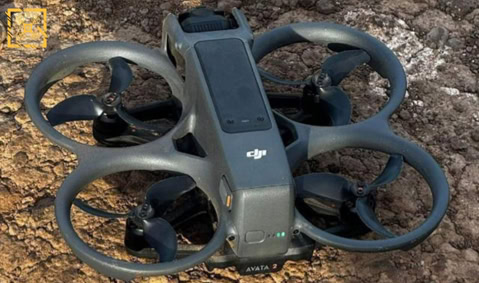
But the real star of the talk was someone else. The DJI Avata 360 — presented on March 26, on sale from the end of April in many European markets — it's not simply a better drone. It's a drone that flips a premise.
Specifications, brief: two 1-inch equivalent sensors (2.4 micron per pixel), 8K 60fps spherical video in HDR, 360° 120-megapixel photos, Single Lens mode that transforms it into a classic 4K/60fps FPV, twenty-three minutes of declared flight time, an entry price around 459 euros. Its direct competitor, Insta360's Antigravity A1—which opened the category in late 2025—is around $1,599. Avata 360 halves that and removes one argument.
But the specifications are the shell. Inside is the revolution: you fly, he'll record everything in 360°, and you decide the shot later. In post. In front of the timeline. Open the file, position the keyframes in DJI Studio, you tell the machine where to look moment by moment, and an MP4 comes out with the direction you chose. One pass becomes ten different passes. A virtual gimbal that never existed allows you to rotate the horizon, to apply an FPV effect in post instead of in flight, to choose whether to automatically follow a subject with ActiveTrack 360° or to reinvent the sequence.
03 / The photographer after preventionCartier-Bresson in front of the timeline
I compose, therefore I am. Photography, from Niépce onwards, is an act of prevention. You see the scene, you imagine it framed, you choose where to place yourself, what to include, what to exclude, when to press the shutter. Cartier-Bresson called it The decisive moment and the key point wasn't the timing—it was the decision made first that the moment would come. The composition was a form of anticipation of reality.
The Avata 360 moves that act elsewhere. The decisive moment is no longer above the snow-covered village—it's at three in the morning, in front of DJI Studio, as you decide whether to tell that sequence from above or below, whether to rotate towards the tower at the end or the beginning, whether to isolate the subject with automatic tracking or let it get lost in the landscape. The shot has become an editing operation.
There's something liberating about all of this, I understand. You can never “mess up” the shot again, because the shot hasn't been taken yet. You've captured everything. You decide later. It's the dream of anyone who's ever thought, “if only I had turned around ten seconds earlier.” It's post-photography applied to the air.
But there's also something that unsettles me. Composing is first a gesture of the body: you move, you lower yourself, you wait, you decide that this It is the point and that one It is not. It is an act of renunciation—because a shot, to exist, must exclude everything else in the world. Composing afterward is an act of archiving: you have the whole world inside the file, and selecting becomes the work of an editor, not a photographer. They are two different professions that now coexist within the same tool.
04 / The Slow RuleWhat ease does not erase
Biagini, in his talk, repeats something that I thought I heard said in a minor key. The secret, he says, is Everything is very slow. Cinematic mode, fluid movements, never jerky. If the drone moves in jerks, the result is awful, even with 8K. Even with 360°. Even with AI reframing in post.
And it's curious – because amidst the technological revolution, the global one, the “choose it all later” mentality, the rule that remains the same is a rule of patience. The same one that has always applied: you don't photograph a thing, you photograph the time that passes over that thing. The resolution changes, the tool changes, the decisive moment migrates from the viewfinder to the timeline, but time continues to be the only ingredient that no machine truly automates.
Perhaps this is where the photographer remains. Not in the shot — that was taken from him in flight. But in the choices he makes about when, the light, the weather, the path he decides to trace through the air. The patience he exercises between takeoff and landing. The editing he does afterward, choosing what to tell and what to leave in the 42 GB file.
It's not a little. But it's not what we were used to.
Biagini's talk is one thing, Davide Vasta's post is another, and this here is the third — mine. Three different voices on the same fact: that today a small drone applauds itself instead of us, and we are there looking at our hands like Macbeth. Except instead of blood, we find the frame. Which until yesterday was ours, and now it's no longer clear whose it is.
 Italian
  English
  German
  French